The Cello
The name violoncello
was really first used in the mid-17th century, but bass violins of one
kind or another are mentioned throughout the 16th and early 17th centuries.
The instrument originated in the early 16th century as a member of a
whole family of instruments of different sizes and with varying compasses,
known as 'viole da braccio'. These instruments were considerably larger
than the standard modern cello, some having a body length of 80 cm or
more. During the 18th century the instrument became smaller in size
and the neck and fingerboard were lengthened and curved more sharply
introducing more or less the instrument we know today as the cello.
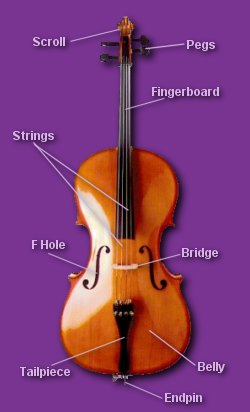
The cello is the
second largest member of the string family. It has a warm, melodious
sound and is used as a solo instrument as well as providing a bass line
in symphonic and chamber music. Composers that have written music for
the cello include Bach, Haydn, Dvorak, Elgar and Saint Saens.
The cello is played
sitting down and normally with a bow. With 1/4, 1/2, 3/4 and full size
cellos available the instrument can be started at an early age. Cases
can range from basic nylon covers, to padded bags with straps to hard
plastic or fibreglass cases.
 |
Below
you will find links to some simple cello lessons. |